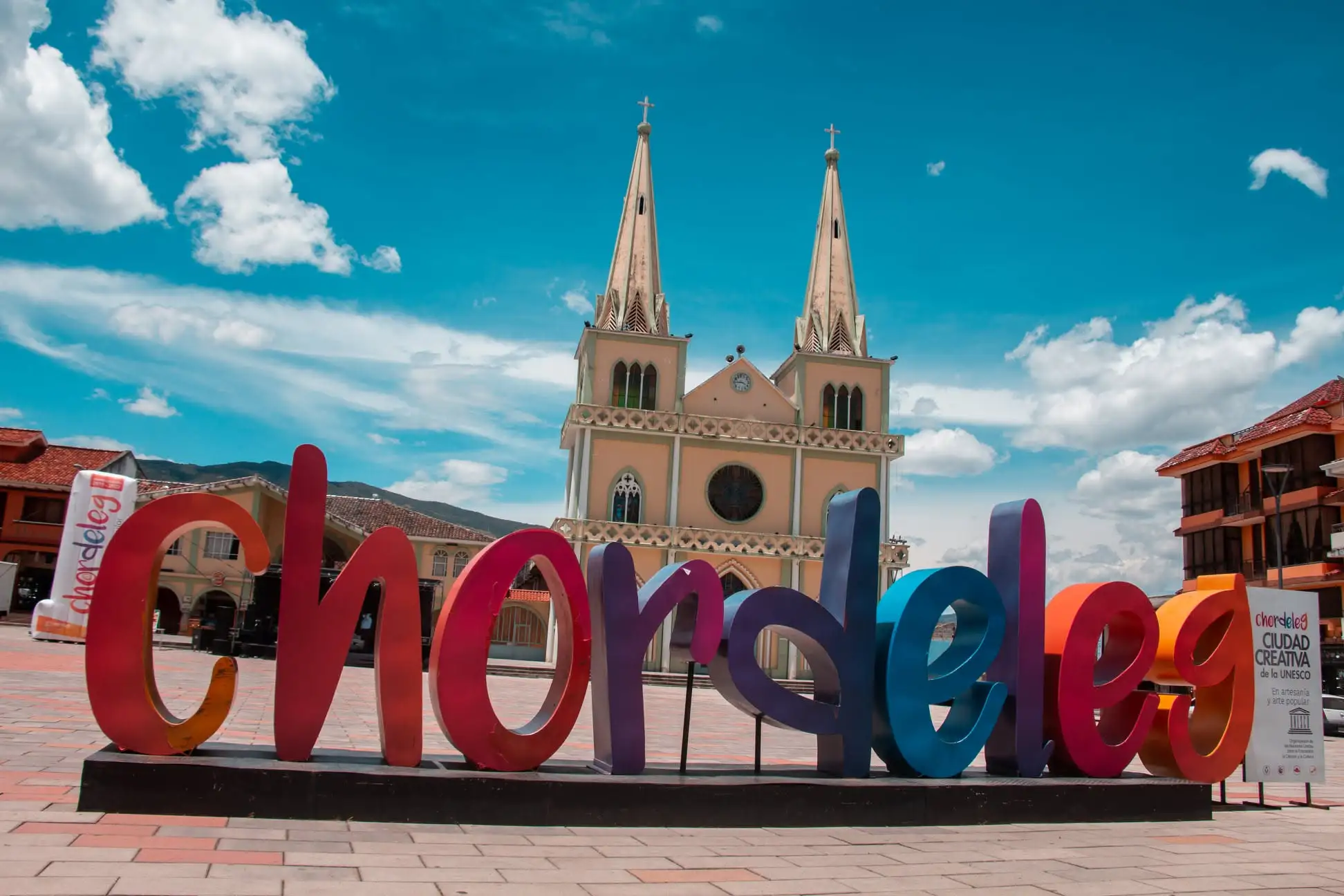
2,230 m a.s.l. · Azuay · Ecuadorian Andes

Chordeleg

A valley where the strike of hammer upon anvil is not an isolated craft, but the daily heartbeat that has sustained whole generations.

Cañari etymology

Shor-Deleg

Sacred Sepulchre Field

Archaeology

800 d.C.

Llaver Ruins (800 AD)

Unbroken Lineage

Master Filigree Makers

From Fidel Zúñiga to Juan Octavio Jara

Craft Community

UNESCO Creative City

+200 artisanal workshops

Chordeleg Valley, Azuay Province, Ecuador
Artisanal Enclave

Chordeleg Valley, Azuay — UNESCO Creative City

Chapter I — The Sacred Origin and Memory of Cañari

Long before being a town, it was the dwelling of metal

According to the history that the Municipal GAD of Chordeleg itself preserves as the official memory of the canton, the origin of the town dates back to the birth of the Cañari tribes. Legend has it that, after a great flood, two brothers managed to survive by taking refuge at the top of Mount Fasayñan. One of them took as his wife a woman with the appearance of a macaw – half bird, half woman – and from that union the first Cañaris were born. It is not a decorative anecdote: it is, literally, the record that the canton uses to explain its own origin.

The name itself says so, although for years the local tourist slogan has preferred another version. The most repeated reading by historians and by the Municipality itself derives "Chordeleg" from the Cañaris words Choch or Shor (hole, sepulchre) and Deleg (plain): "Field of the Sepulchre". The linguist Oswaldo Encalada Vásquez offers a second reading, the result of a Quichua-Cañari hybridization: churu (snail, zigzag) and deleg (large plain) — "snail-shaped plain." Both agree on something: the label of "Chorro de Oro" that is sometimes used to promote the canton is, according to Encalada Vásquez himself, more slogan than etymology.

What is documented is that this plain was, in Cañari times, a sacred cemetery reserved for the main chieftains and kings of the region, buried along with gold, silver and ceramic objects — a privilege that, according to the historical records of the canton, did not extend to the rest of the population. Around the year 800, on top of a hill now known as the ruins of Llaver, what local tradition describes as a mythical space marked by a formation of stones in the shape of a snake was erected. For generations, huaqueros excavated these tombs in search of the gold and silver pieces that accompanied them — the same archaeological heritage that the historian and archbishop of Quito Federico González Suárez was among the first to systematically document. Before a single thread of filigree was stretched in this valley, the earth already knew that the precious metal was not just any commodity: it was what was taken to the afterlife.

"Before a single thread of filigree was stretched in this valley, the earth already knew that the precious metal was not just any commodity: it was what was taken to the afterlife."

Chapter II — The Millimetric Technique and the Family Lineage

Silver threads thinner than a human hair

Filigree, the technique of intertwined threads that defines Chordeleg today, came later, during the Colony, brought by Spanish silversmiths who in turn had inherited it from the Iberian tradition under Islamic rule. What is distinctive about Chordeleg is not that he received it – several Andean cantons did – but how he decided to keep it: unlike other places where the trade was fragmented over time, here the knowledge was maintained within complete family lineages.

The historical record of the canton recognizes Fidel Zúñiga as one of the great filigree masters of the first half of the twentieth century. Zúñiga transmitted his trade to his nephew, Juan Octavio Jara, today considered a pioneer of the technique in the canton. Jara travelled in his youth, returned to Chordeleg in 1980 and, after a period of rest, opened his first jewellery shop – El Gran Chaparral, which would later be known as Puerta del Sol. There she not only worked with traditional jewelry: she created three-dimensional filigree sculptures — condors, dragons, pieces that can take up to eight months of work — that today are sold in jewelry stores throughout Ecuador, including the Galapagos Islands. One generation passing on to the next, without the thread being cut once: that's what makes Chordeleg a cradle, and not just a dot on the map.

Chordeleg's filigree is unlike any contemporary manufacture. It begins with a hand-cast 950 silver bar. The goldsmith repeatedly stretches it through rows of carbide until he obtains strands of tenths of a millimeter. Two of these microscopic threads are twisted together on a wood to give it the texture of a cord. With watchmaker's tweezers, the master fills pre-forged structural frames, assembling traditional geometric and floral motifs. Finally, with a blowtorch of dim flame and welding file, he joins hundreds of microscopic points in a single instant without melting the delicate weave.

Chapter III — The Ecosystem: Master First

A commitment to the master\u0027s endurance

PLIMAN does not manufacture in its own workshop within this valley — it is not necessary: Chordeleg already supports, according to the Municipality's own count, more than two hundred artisan workshops among its streets. What we do is different: within that community of masters that this valley has preserved for generations, we look for each piece the artisan whose exact specialty – forging, setting or filigree – the technique requires. There is no single "PLIMAN goldsmith"; there are as many as there are different techniques our archive needs, and each one is paid for what his specialty is really worth.

This way of working is only possible because the geographical isolation of this Andean valley never allowed the trade to become industrial. The hours a master spends casting, stretching, and intertwining a 950 silver or 18k gold wire are not dictated by an assembly line, but by fire tolerance and the patience of the hand. In 2017, when UNESCO incorporated Chordeleg into its Creative Cities Network, it did nothing more than confirm internationally something that this valley already knew about itself before it had a name: that true luxury is not noise, but the meticulous silence of a land that has had centuries to learn to wait.

PLIMAN does not come to Chordeleg to impose foreign designs or create artificial factories. It arrives as an archive of provenance that generously and dignifiedly compensates the time every master needs to forge a masterpiece. If the master lives with dignity from their art, filigree will thrive for another five hundred years.

Chronicles of the Craft · Historical Investigation

Chordeleg: Cradle of Noble Metals

Before it was famous for its filigree, this Andean valley was already, according to its name, a sacred field of golden tombs. This is the actual genealogy of the land on which we work.

Read Chronicle
Living Memory
“When one acquires a PLIMAN jewel, one does not buy an inert object: one safeguards a piece of Chordeleg\u0027s millennial memory hand-forged by its rightful creators.”

PLIMAN · Imperial Silver of the Andes

Explore the Craft

Meet the goldsmiths in our archive or discover the step-by-step workshop forging sequence.